When your wearable alerts: spotting warning signs, using telehealth, and getting the right care
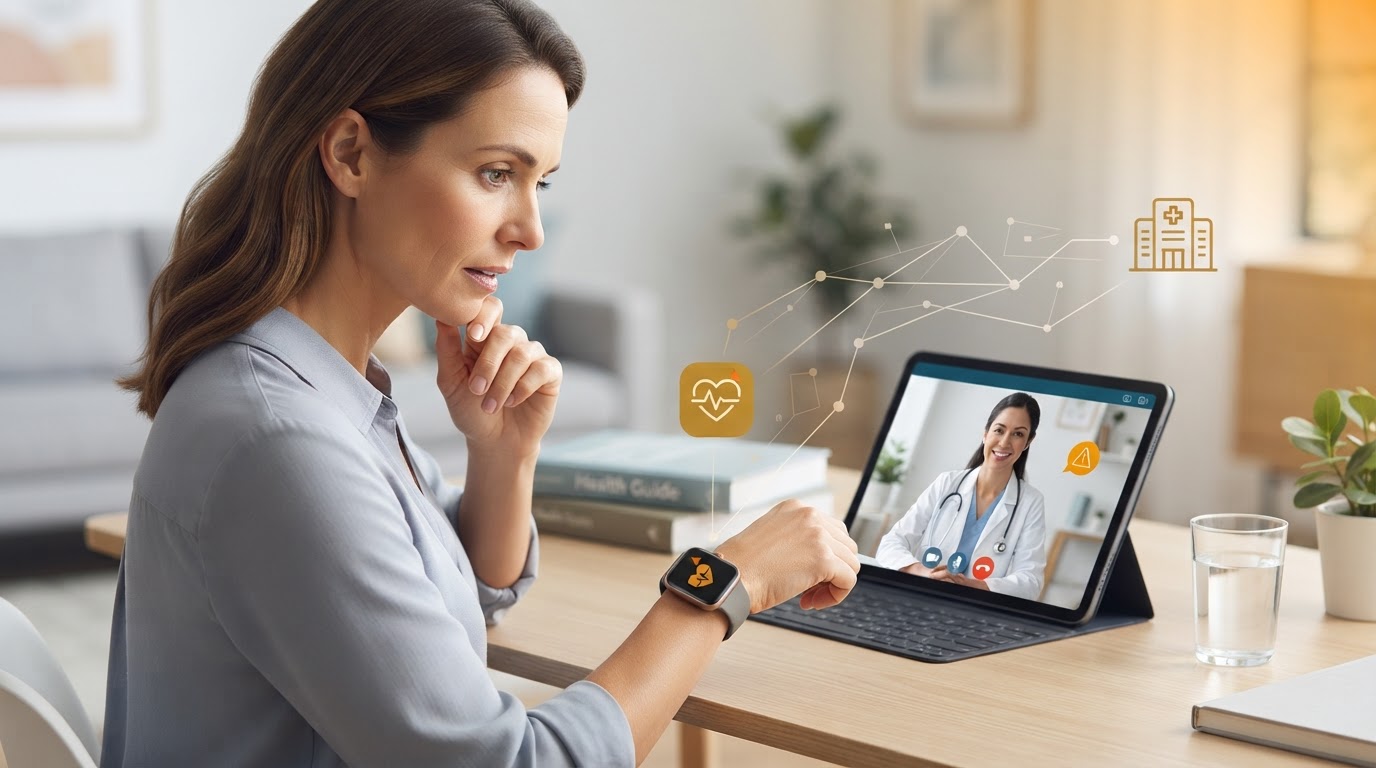
Wearable alerts can leave you wondering whether to call a doctor, book a telehealth visit, or get help immediately. The safest response starts with how you feel, then uses the alert’s timing, pattern, and your medical history to help determine the right care.
A smartwatch notification or glucose alert is a signal to interpret, not a diagnosis to accept on its own. This guide explains how to recognize urgent warning signs, gather useful information, choose between remote and in-person care, and make sure an alert leads to a clear follow-up plan rather than more uncertainty.
When wearable alerts need emergency attention
What should you do after a wearable alert? Check for symptoms first. If you have chest pain, significant shortness of breath, fainting, stroke symptoms, or severe palpitations, seek urgent medical help; severe or ongoing symptoms warrant emergency services rather than waiting for telehealth. Otherwise, save the alert, note its timing and pattern, and contact your care team for guidance.
The most important distinction is between a device notification and a person who may be seriously unwell. A watch cannot make that distinction for you, and gathering a perfect record should never take priority over getting help for concerning symptoms.
If you think you may be having a medical emergency, call your local emergency number. Do not wait for the device to issue another warning, for a portal message to be answered, or for the next available video appointment.
Put symptoms a of the screen
Chest pain, shortness of breath, fainting, stroke symptoms, and severe palpitations are important warning signs when they occur alongside an alert. Depending on their severity, emergency services or prompt in-person assessment may be more appropriate than a remote appointment.
The reverse situation matters too: feeling seriously unwell without receiving an alert does not mean it is safe to wait. A consumer device is not a substitute for assessment of symptoms, and the absence of a notification should not override a concern that you need urgent help.
- Severe or ongoing warning symptoms: Seek emergency help rather than troubleshooting the device.
- Symptoms whose urgency is unclear: Seek prompt clinical triage through an available service, explaining both the symptoms and the alert.
- No concerning symptoms: Review what the notification actually says and arrange appropriate follow-up based on your history and any existing care plan.
Use a personal action plan when you have one
If a clinician has already given you instructions for a monitored condition, those instructions provide more useful context than generic advice. Keep them accessible, including what should trigger a call, who to contact after hours, and when to bypass routine messaging.
For example, someone enrolled in a clinical monitoring program may have a named team and an agreed response pathway. Someone using a smartwatch independently may need to begin with primary care or a triage service. Neither person should assume that an alert is automatically being reviewed by a professional.
Check what the device detected before drawing conclusions
Once urgent symptoms have been addressed, the next step is to understand the notification itself. A practical clinical approach begins with the device type, the timing of the event, and whether it was isolated or part of a pattern.
Read the alert’s exact wording rather than translating it into a diagnosis. A message about a possible rhythm irregularity, for instance, is not the same as a clinician confirming a heart condition. Preserving that distinction helps you explain the issue accurately and avoid unnecessary alarm.
- Identify the device and feature. Record the device name and whether the alert concerned heart rate, rhythm, glucose, or another measurement.
- Save the original information. Keep a screenshot, recording, or report if the device provides one. Include the date and time rather than relying on memory.
- Describe the pattern. Note whether this happened once, recurred over several days, or represents a change from your usual readings.
- Add what you were experiencing. Write down any symptoms and whether they occurred before, during, or after the notification.
- Include the surrounding context. Note whether you were asleep, resting, active, or recovering from an illness, without assuming that the context explains the result.
Separate device questions from medical questions
Device instructions or technical support can help you understand how a feature works and how to retrieve its records. They cannot determine whether your symptoms need medical assessment. Likewise, repeatedly checking settings is not an appropriate response to an urgent health concern.
If you are well enough to review the device, check that you are using it according to its instructions. Avoid trying to “prove” the alert wrong through repeated measurements. Your clinician needs a clear account of the original event, not necessarily an expanding collection of readings taken while you are worried.
Timing also helps connect the alert with your clinical history. Tell the care team about relevant diagnoses, recent illness or procedures, and medication changes. These details allow the measurement to be considered as part of your health picture rather than as an isolated number.
If you cannot retrieve a detailed report, describe what you saw as accurately as possible. Missing a screenshot is not a reason to postpone seeking care; it simply becomes one of the limits the clinician considers.
Understand what wearable health data can,and cannot,tell you
Wearables can help track trends in sleep, activity, heart rhythm, and glucose, depending on the device. Recent NIH coverage also describes devices that measure heart rate, skin temperature, and sweat, reflecting how broad this category of technology has become.
Those measurements do not all answer the same clinical question. A sleep trend, a heart rhythm recording, and a glucose alert require different interpretation. The presence of a health-related number on your wrist or phone does not mean that number has a clear diagnostic meaning for you.
Screening, diagnosis, and monitoring serve different purposes
- Screening looks for a possible issue that may deserve further evaluation. An alert can raise a question without answering it.
- Diagnosis involves a clinical assessment that considers the relevant history, symptoms, and any appropriate testing.
- Monitoring follows a known concern or condition over time, ideally with agreed rules about which changes require action.
A recent JAMA perspective describes wearable measurements as an expanding stream of patient-generated health data that clinicians increasingly need to interpret alongside traditional evaluation. The key word is “alongside”: the information adds context rather than replacing the rest of the assessment.
Research involving people after percutaneous coronary intervention, or PCI, similarly emphasizes verifying wearable findings through standard clinical assessment. In practical terms, a device report may help focus a conversation, but it should not be treated as stand-alone diagnostic evidence.
Patterns need personal context
Recent digital cardiology reviews emphasize the importance of context-specific alert thresholds and each patient’s baseline variability. A threshold is the point at which a system generates a warning; whether that warning is useful depends partly on the person and the purpose of monitoring.
This is why comparing your alerts with someone else’s is rarely enough to decide what to do. Two people can receive similar notifications while having different symptoms, medical histories, and follow-up needs. Your own usual pattern is useful context, but it does not independently establish that a new change is harmless.
Continuous monitoring has shown promise for detecting deterioration earlier in hospital settings. However, optimal thresholds and response workflows remain active research questions. Evidence from a monitored hospital environment should not be interpreted as a guarantee that a personal device can detect every important problem at home.
Decide whether telehealth or in-person care fits the situation
Telehealth can provide a practical route to clinical interpretation when an alert does not require emergency care. A remote visit gives you a way to discuss symptoms, review the device record, and decide whether you need an examination, testing, or ongoing follow-up.
It is also an established part of care delivery. HHS reports that 95% of HRSA-funded health centers used telehealth to provide primary care in 2024, and 25% of Medicare fee-for-service users received a telehealth service that year. Those figures describe its use, not a guarantee that every service can assess every wearable concern remotely.
When a remote visit can be a useful starting point
If you have no emergency warning signs, a telehealth appointment may help clarify the next step. This is especially practical when your main need is to explain a notification, review a recurring pattern, or ask how a change fits with an existing condition.
The clinician can determine whether the available information is enough for an initial plan or whether an in-person evaluation is needed. A successful remote visit does not have to end with a remote diagnosis; directing you to the right setting is itself a useful outcome.
- Telehealth offers access and discussion: You can review the timeline, symptoms, and available records with a clinician.
- In-person care offers a different type of assessment: Some questions require a physical examination or testing that a call cannot provide.
- Emergency care addresses urgent risk: It should not be delayed while trying to obtain a routine remote appointment.
Check access, technology, and coverage separately
Medicare telehealth flexibilities have been extended through December 31, 2027. As of January 1, 2025, audio-only telehealth can also be used in certain home-based situations when video is not technically possible or the person does not consent to video.
These provisions do not mean every appointment, clinician, or service is covered in every circumstance. Before a nonurgent visit, ask the practice and your insurer about eligibility, costs, and whether video is necessary for the service being offered.
If video is a barrier, explain that when scheduling rather than simply abandoning follow-up. Ask whether an audio-only visit is appropriate and available, or whether a telephone triage service or in-person appointment would better meet your needs. The best route is one that is both accessible and clinically suitable.
Prepare for a telehealth visit about a wearable alert
A concise summary is often more useful than sending an unorganized stream of measurements. Your goal is to make it easy for the clinician to understand what happened, how you felt, and what decision you need help making.
Start with the reason for the visit in one or two sentences. For example: “My watch reported a possible rhythm issue twice this week. I saved the reports, and I want to know whether I need further assessment.” This describes the concern without claiming a diagnosis.
Bring a focused set of information
- The original alert: Its wording, date, time, and any report or recording available.
- The event timeline: Whether it was a single episode or a repeated pattern, and how it differs from your usual device data.
- Your symptoms: What you felt, when it happened, whether it has resolved, and whether it has returned.
- Your clinical background: Relevant conditions, recent illness or procedures, and your current medication list, including recent changes.
- Your main question: Whether you need testing, an examination, a monitoring plan, or clarification of an existing plan.
Ask the practice how to share records securely before the appointment. Some services may be able to review an uploaded report; others may need you to describe the alert during the visit. Confirming the process beforehand can prevent the appointment from being spent trying to move files between systems.
If you have a large amount of data, ask which period or report is most useful. You do not need to assume that every minute of monitoring deserves equal attention. Highlighting the relevant events helps preserve the connection between the readings and your actual concern.
Leave with answers to decision-focused questions
- Does this alert call for an in-person assessment or any additional testing?
- Which symptoms should make me seek urgent or emergency care?
- Which future alerts should I report, and through what channel?
- Should I continue collecting the same data, or focus on something more specific?
- Who will review any results, and when should I expect to hear back?
If the answer remains uncertain, ask the clinician to explain what information would resolve that uncertainty. That may be an examination, a test, a clearer symptom history, or follow-up over an agreed period. A useful plan makes the next decision explicit rather than leaving you to interpret the next notification alone.
Make sure remote monitoring leads to clear follow-up
Receiving an alert and receiving care are not the same thing. One of the most important questions is whether anyone is responsible for reviewing the information and acting on it.
Do not assume that connecting a device to an app means a clinician is watching continuously. Ask whether the data are part of a formal monitoring program, whether the team receives notifications, and what happens outside normal service hours. If no one has explained the arrangement, clarify it before relying on it.
Know the difference between personal tracking and a care service
Personal tracking lets you collect information for yourself and potentially share it later. A clinical remote monitoring service should have an agreed process for reviewing relevant information and responding. The presence of a connected device does not, by itself, establish that process.
Recent reviews of wearables and remote monitoring stress defined triage rules, clear responsibilities, and closed-loop follow-up. Closed-loop follow-up means that an issue is not merely sent or recorded: someone reviews it, an action is communicated, and the patient knows what happens next.
- Responsibility: Who reviews alerts, reports, or messages?
- Timing: When are they reviewed, and what should you do while waiting?
- Escalation: Which findings lead to a call, an appointment, or urgent assessment?
- Confirmation: How will you know the team received and addressed your concern?
- Backup: What is the plan if technology fails or the service is unavailable?
More monitoring is not automatically better care
A 2026 randomized clinical trial found that nurse-supported remote monitoring after sepsis or lower respiratory tract infection did not increase time at home. That finding concerns a particular population, intervention, and outcome; it does not establish that all remote monitoring is ineffective.
It does show why the value of monitoring cannot be judged simply by how much data it generates. The measurements must connect to decisions and care processes that help the people being monitored.
If an alert leads to testing or a referral, confirm who is responsible for the result and next step. If the expected response does not arrive, use the agreed contact route to follow up. New or worsening urgent symptoms, however, belong in an urgent care pathway rather than an unanswered routine message.
Reduce alert anxiety without ignoring meaningful changes
Repeated notifications can make it difficult to stop thinking about your health. A 2026 scoping review in cardiovascular patients describes anxiety and excessive reassurance seeking as concerns when people overinterpret wearable alerts.
The goal is not to dismiss every notification or to monitor yourself constantly. It is to agree on a manageable response that distinguishes meaningful changes from information that does not require immediate action.
Replace repeated checking with an agreed plan
If each alert sends you back to the app for more readings, explain that pattern to your clinician. Ask what you should record, which events deserve contact, and whether your current use of the device is supporting the purpose for which you wear it.
Also describe the practical impact: interrupted sleep, difficulty concentrating, or repeated requests for reassurance. These effects matter when deciding whether a monitoring approach is useful for you. They should be part of the care discussion, not treated as an unrelated problem.
- Keep the written action plan somewhere easier to find than a long app history.
- Use the agreed contact route instead of sending the same concern through several channels.
- Ask whether notification settings are appropriate for your situation.
- Discuss changes to prescribed monitoring with the responsible care team rather than turning it off on your own.
Avoid both alarm and false reassurance
Overreacting to every signal can create distress, but assuming that no alert means no problem creates a different risk. A sound plan gives symptoms their own response pathway, independent of what the device reports.
Alert fatigue is another concern: too many signals can make it harder to recognize when action is needed. Recent reviews identify clear triage rules and responsibilities as important safeguards. For patients, that translates into knowing which notifications matter, what action they require, and who can help interpret them.
If you still feel compelled to check repeatedly despite having a plan, bring that up at follow-up. The monitoring strategy may need review, including whether its current burden is justified by its clinical purpose. The aim is useful information that supports care, not an endless demand to prove that everything is normal.
Use wearable trends for prevention without buying into promises
Not every useful wearable signal points to an immediate problem. Some may help start a conversation about prevention, especially when they lead to an appropriate clinical assessment rather than self-diagnosis.
Recent NIH coverage describes researchers exploring whether wearable-based signals can identify prediabetes risk before symptoms appear. Researchers are also studying whether text outreach after an alert encourages people to follow up with a doctor. These are promising questions about earlier screening and engagement, not proof that a wearable can independently diagnose or prevent diabetes.
Distinguish an interesting measurement from a proven benefit
A 2026 JAMA Internal Medicine article notes that, for people without diabetes, there is no good evidence that continuous glucose monitoring improves health or prevents diabetes. It also highlights how frequent alerts can disrupt sleep and increase stress.
This illustrates a broader decision: a device may provide more information without evidence that collecting that information improves health for a particular group. Before adding another sensor or subscription, ask what decision the new data would change.
- Name the goal. Are you trying to understand symptoms, monitor a diagnosed condition, or discuss a prevention concern?
- Ask whether the measurement fits that goal. A useful feature for one clinical purpose may not answer a different question.
- Identify the next step. Decide what a concerning result would lead to and who would interpret it.
- Consider the burden. Include cost, time, sleep disruption, and stress alongside any potential value.
- Review the arrangement. Revisit whether tracking is helping rather than assuming it should continue indefinitely.
If your concern is prediabetes risk, a practical next step is to ask your clinician whether established screening is appropriate. You do not need to wait for a wearable notification to raise a prevention question, nor should you assume that buying continuous monitoring is the necessary starting point.
The same principle applies across wearable health features: define the question before collecting more data. A limited, purposeful use of a device can be more manageable than tracking every available metric without knowing how any result will affect your care.
When your wearable alerts, let symptoms determine urgency and let clinical context guide interpretation. Save the relevant information, use telehealth when it is an appropriate route to assessment, and recognize when an examination, testing, or emergency care is the better next step.
If you have a nonurgent alert you do not understand, contact your care team with its wording, timing, pattern, and any accompanying symptoms. Ask for a clear plan covering what to watch for, who will review further information, and when to seek help,so the next notification comes with a decision pathway, not just uncertainty.

Comments
Post a Comment